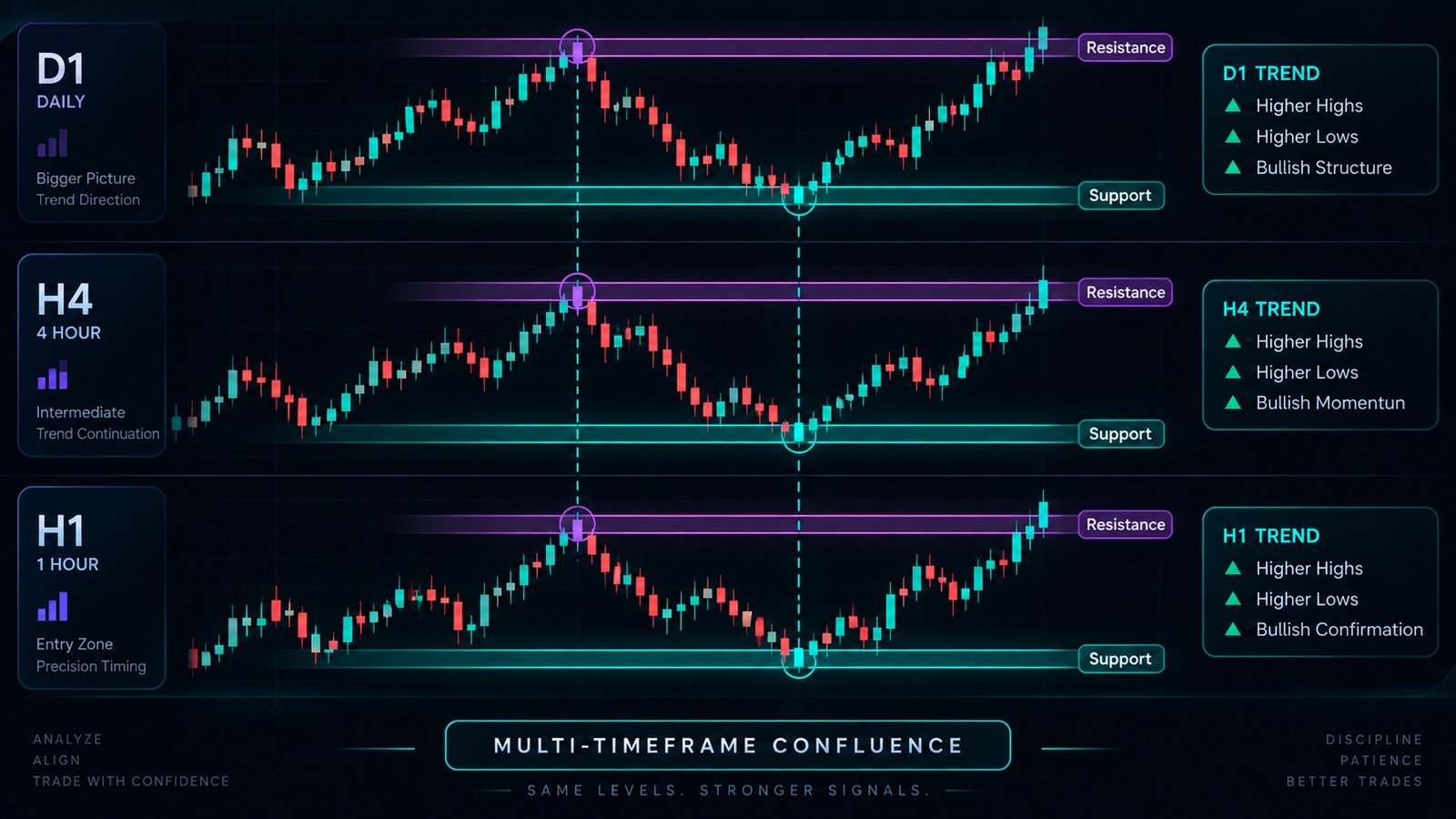
Every crypto trader eventually asks this question: ETH or BTC? Both trade 24/7. Both react to macro. Both are covered by every signal service on the internet. But for a technical trader using levels, they're very different animals. Here's the honest comparison — no maximalism either way.
Volatility: ETH wins (which is not always good)
Ethereum averages 20-40% higher daily volatility than Bitcoin. In a normal week, BTCUSD moves 3-4% between high and low. ETHUSD moves 5-7%. In an active week, ETH can easily double BTC's range.
More volatility means more setups per week. It also means bigger losses when you're wrong, wider stops, and more tail risk overnight. If you're a beginner, BTC's slower tempo is easier to read. If you're an experienced trader who can size positions correctly, ETH's expansion is where the real intraday R:R lives.
Correlation and how it breaks
ETH and BTC correlate around 0.85 on daily returns most of the time. When BTC pumps, ETH pumps. When BTC dumps, ETH dumps harder. This is the base case.
The interesting trades happen when correlation breaks:
- Altseason phase: ETH outperforms BTC by 5-10% weekly. Rotation trade — long ETH, hedge BTC.
- Flight to safety: Any regulatory shock or macro fear, BTC drops 8% but ETH drops 15%. ETH is the higher-beta play.
- Ecosystem-specific news: A big Ethereum upgrade or L2 launch decouples ETH temporarily.
The trader who watches both charts side-by-side sees setups the single-coin trader misses. Divergence is the signal.
Macro drivers: what actually moves each
BTC drivers:
- US ETF flows (BlackRock IBIT, Fidelity FBTC) — public data, watch weekly
- Fed policy and real yields
- DXY (dollar index) — inverse correlation
- Halving cycle (every 4 years)
- Institutional custody + regulation headlines
ETH drivers:
- BTC direction (heaviest single input)
- L2 adoption + gas fees on mainnet
- Staking yield + validator inflows
- DeFi TVL trends
- Ethereum ETF flow (secondary but growing)
Which one respects levels better?
Both respect levels, but differently. BTCUSD respects psychological round numbers hard — $100K, $110K, $120K. Order books stack aggressively at these round levels because everyone from retail to funds uses them as targets.
ETHUSD respects Fibonacci extensions of BTC swings more than absolute levels. When BTC breaks a level, ETH follows within 30 minutes and typically overshoots. Trading ETH is often about trading BTC's next move one candle in advance.
Our AI computes daily zones for both. On BTC, the levels tend to hold as reversal points. On ETH, they act more like acceleration triggers — price breaks through, then extends 2-3x further than BTC would.
Which is easier to trade as a beginner?
BTC. Full stop. Lower volatility, clearer levels, more predictable macro relationships. Start with BTC. Trade it profitably for three months. Then add ETH as your second symbol.
Starting with ETH is like learning to drive on a race track. The volatility that experienced traders love will destroy a new account in a week.
The 2026 macro backdrop
Right now, both coins trade above their 200-day moving averages. Fed is on hold. ETF flows remain net positive. That's a supportive tape. But we're also mid-cycle — the biggest 4-year returns typically come in the year after halving, and we're past that. Expect chop-with-uptrend, not parabolic.
In this environment, level-based trading beats trend-chasing. Wait for our daily buy above / sell below zones. Take the reversal from the sell-below when it holds. Take the breakout from the buy-above only with volume confirmation. Small edge, applied consistently, compounds.
The trader's answer
Trade both. Watch BTC first — it's the leading indicator. Take BTC setups when they line up with our zones. Add an ETH position sized 40% of your BTC position when correlation is normal (0.85+). Cut the ETH first when things go wrong; it'll fall faster.
See today's BTC levels and today's ETH levels side by side. Or open the terminal to chart both at once.
Educational content only. Not financial advice.