Every trading site promises "AI-powered signals" these days. Most of them are the same three moving-average crossover strategies dressed in a fresh wrapper. The word "AI" has been diluted to meaninglessness. So let's cut through it. Here's what AI in trading actually is, what it can and can't do, and how to evaluate whether a signal service is real or theater.
What "AI" actually means in trading
In practice, AI in trading breaks down into three categories:
- Statistical/econometric models — regressions, ARIMA, GARCH, cointegration tests. Been around for 50+ years. Still the workhorse of quant desks.
- Machine learning — supervised classifiers (random forests, gradient boosting) and unsupervised methods (clustering, PCA) trained on historical price and volume data.
- Deep learning — LSTMs, transformers, CNNs applied to time-series or order-book data. Powerful but very data-hungry.
Real trading firms use all three, layered. Retail signal services mostly use #1 relabeled as #3 for marketing.
What AI is genuinely good at
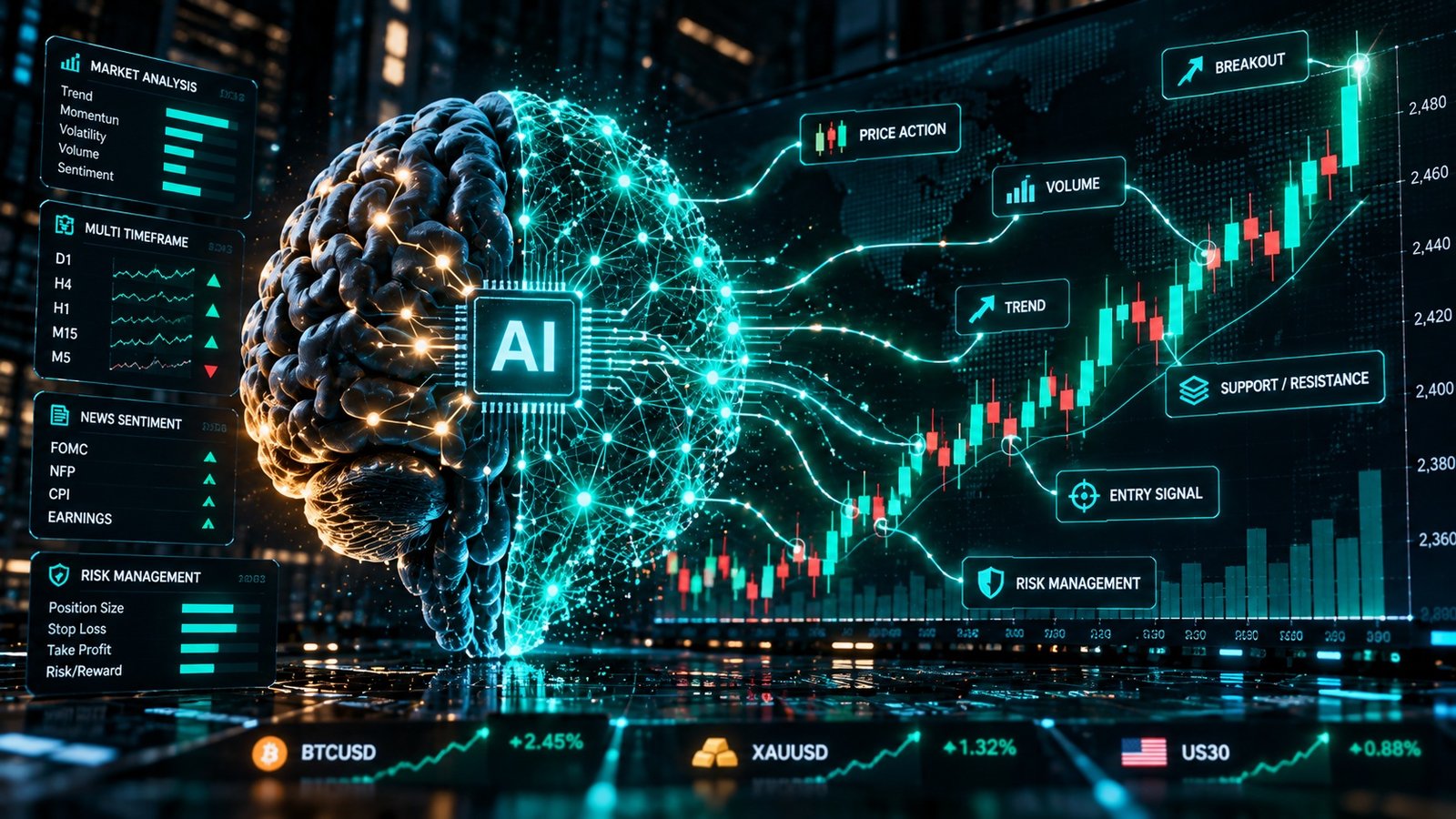
Pattern detection at scale. A human can watch 5 symbols at once. An AI can watch 500 and flag the ones showing statistically significant patterns. This is where our engine spends most of its cycles — scanning 100+ instruments for setups that match historical high-probability configurations.
Volatility regime classification. Is the market in a trending regime or a mean-reverting regime? The strategies that work in each are opposite. AI models trained on volatility, autocorrelation, and correlation-cluster data can flag regime shifts hours or days before a human trader would notice.
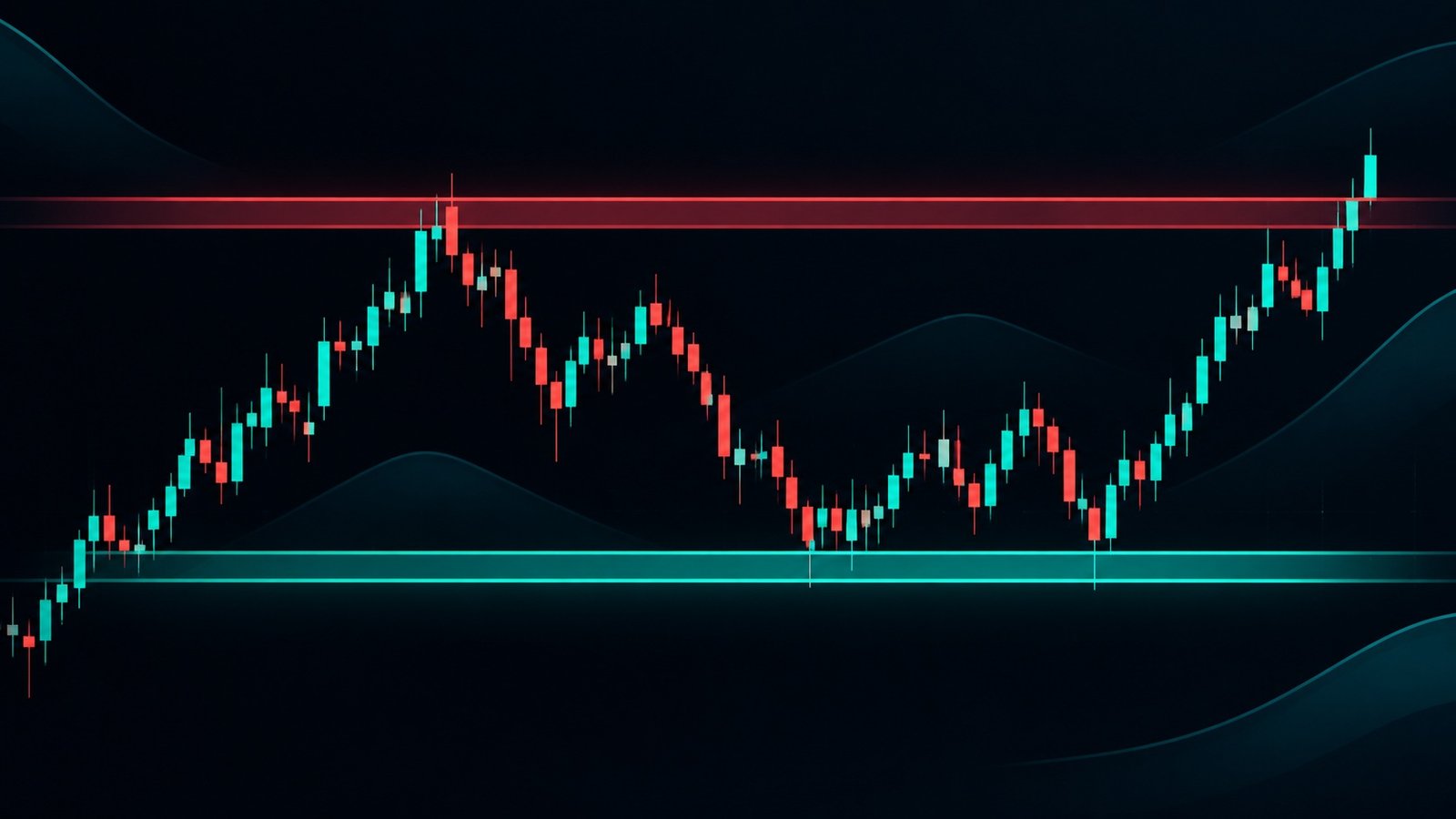
Level generation. Instead of drawing support/resistance by eye, an AI can compute levels using order-book depth, historical reaction data, volume profile, and volatility bands — combined into one number. That's what LevelEngine does for daily buy above / sell below zones.
What AI is genuinely bad at
Predicting news. No model reliably predicts a Fed pivot, a war, a bankruptcy. AI is trained on historical patterns — the moment a truly unprecedented event happens, the model is worse than a coin flip.
Adapting to regime change fast. A model trained on 2015-2020 data underperformed in the 2022 rate shock. Models decay. Every AI trading signal you see has an implicit "last calibrated" date.
Handling illiquid or thin markets. When spreads widen and volume dries up, historical price relationships break. AI models are usually worst exactly when volatility is highest — which is when traders most want them to work.
The biggest lie in retail AI trading is that the model beats markets. The truth is: good models produce a small edge (52-55% win rate) that compounds when combined with disciplined risk management. That's not glamorous but it's real.
How LevelEngine's AI actually works
Our engine produces one thing: daily buy above and sell below zones for each covered symbol. Here's the pipeline:
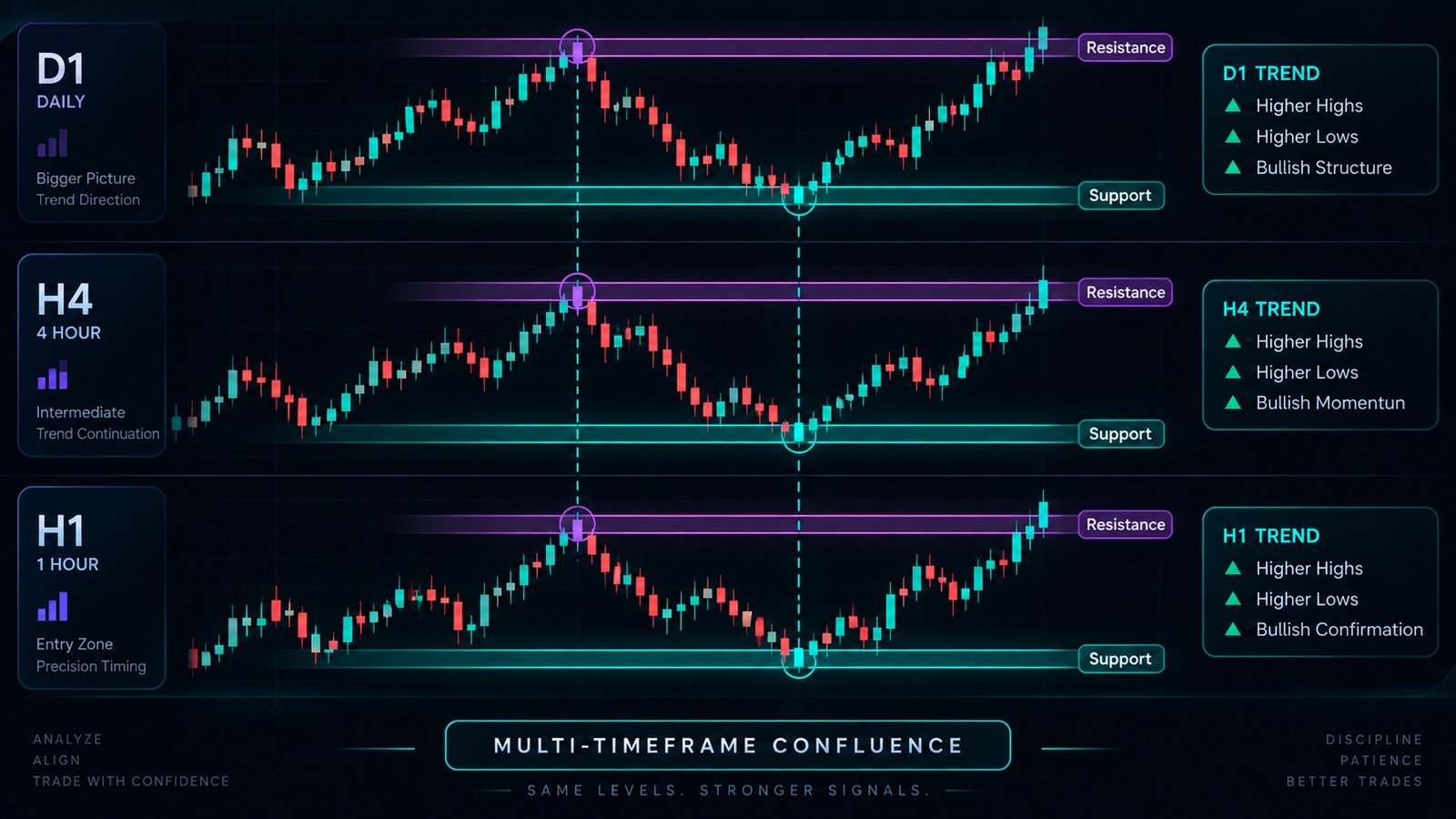
- Data ingest. Every 60 seconds, we pull tick data, D1/H4/H1 candles, and volume from primary exchanges for 100+ symbols.
- Feature computation. ~40 features per symbol: ATR bands, VWAP distance, volatility percentile, session-based volume ratios, correlation to related symbols, macro-event proximity.
- Zone calculation. A gradient-boosted model produces a probability distribution over "next 24-hour highest sustainable long entry" and "lowest sustainable short entry." The daily zones are the median of that distribution ± volatility-scaled bands.
- Backtest + calibration. Every zone is checked against how similar setups have performed in the last 60 days. If the model is decaying (recent hit rate down), the zone gets a wider band.
- Publication. Free tier gets D1 refreshed at 23:00 UTC daily. Pro tier gets H4 and H1 refreshes on candle close throughout the day.
Published hit rates — the only metric that matters
Any signal service that doesn't publish honest hit rates is selling hope. Here are ours, rolling 30-day, first day of month:
- XAUUSD: 97% level touch rate (a "touch" = intraday price came within ±0.15% of a plotted zone)
- BTCUSD: 91%
- EURUSD: 96%
- US30: 95%
- NAS100: 92%
Touch rate is not win rate. Just because price touches a zone doesn't mean you should blindly take the trade. That's why we ship the AI Copilot alongside the levels — to help you decide when a touch is a real setup versus a sweep.
How to evaluate any AI signal service
Ask these five questions before paying anyone:
- What model type? If they can't tell you, walk away.
- What's the rolling 30-day hit rate on the specific instrument you'd trade? Not a screenshot — a live-refreshed metric.
- How often does the model retrain or recalibrate? Weekly is fine, quarterly is stale.
- What happens during major macro events (NFP, CPI, FOMC)? Do they suspend signals or push through?
- Can you see the last 30 signals and their outcomes? If they hide history, they're hiding losers.
The honest summary
AI trading signals are a tool, not a magic answer. A good AI system augments a disciplined trader by pre-computing high-probability zones, freeing them to focus on entries, sizing, and macro context. It does not replace judgment. It does not eliminate losses. It does compound edge over hundreds of trades — if you actually take the setups with discipline.
See how our AI-generated zones look on your favorite symbol: XAUUSD, BTCUSD, EURUSD, or open the terminal to chart 100+ symbols.
Educational content only. Not financial advice.