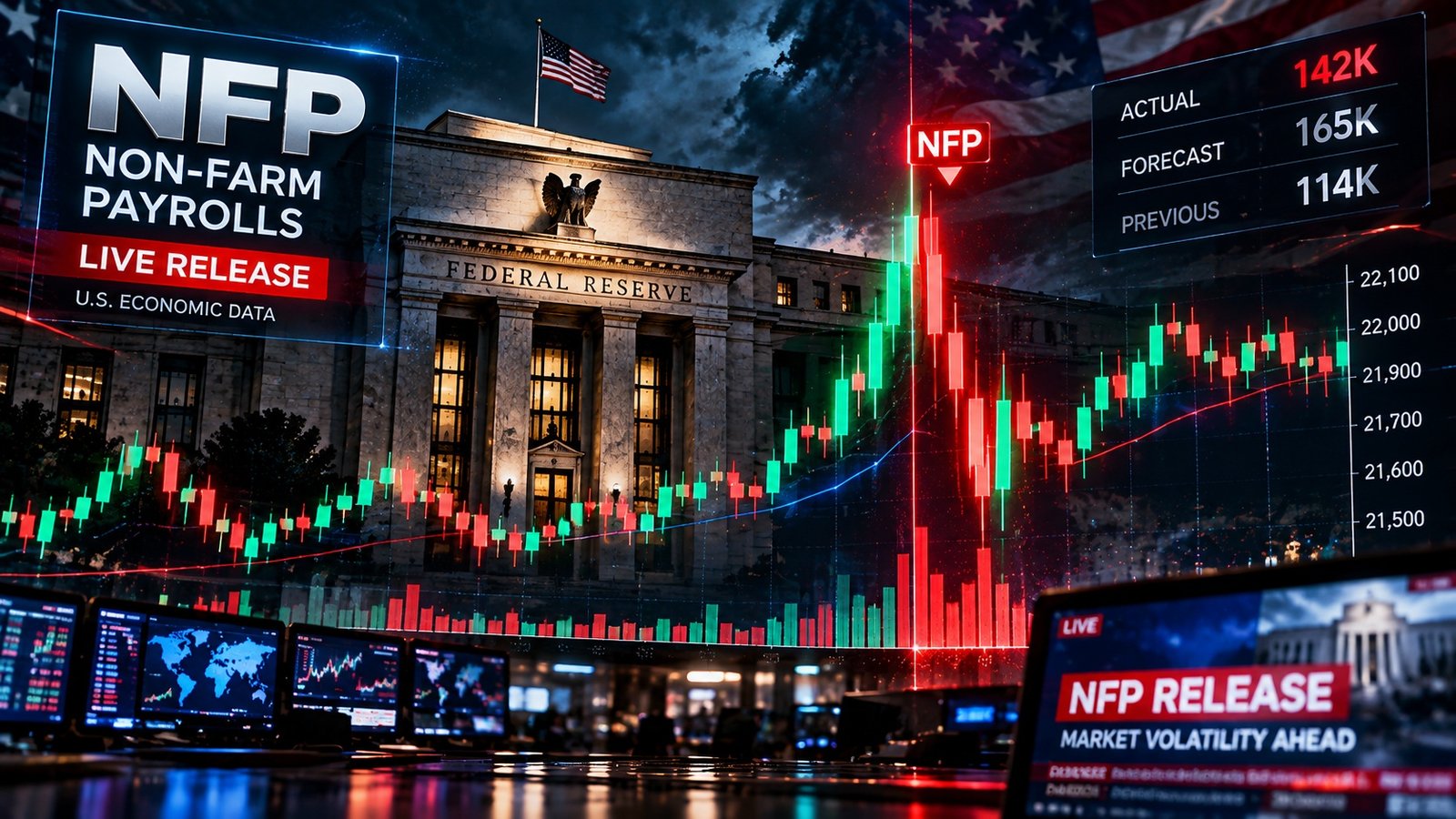
Non-Farm Payrolls prints at 12:30 UTC the first Friday of every month. In 60 seconds, it can move XAUUSD 40 dollars, EURUSD 80 pips, and US30 300 points. It's the biggest recurring event on the trader's calendar. Most people lose money on it because they treat it like a coin flip. Here's the playbook.
What NFP actually measures
NFP reports the number of jobs added or lost in the US during the previous month, excluding farm workers, government workers, and non-profits. It's released by the Bureau of Labor Statistics with three headline numbers: jobs added, unemployment rate, and average hourly earnings (wage growth).
Markets don't just react to the top-line jobs number. Wage growth often matters more — hot wages mean sticky inflation, which means the Fed can't cut rates. That single line item can flip the whole reaction.
Pre-release: the setup nobody talks about
The 12 hours before NFP are almost always the same pattern: range compression. Volume dies. Spreads may widen slightly. Everyone is waiting.
This is your prep window. Between 20:00 UTC Thursday and 11:00 UTC Friday, do three things:
- Mark the pre-NFP range. High and low of the last 12 hours. These become your break-out levels.
- Check consensus. Bloomberg, ForexFactory, or Reuters — know what economists expect. The number itself doesn't matter as much as whether it beats or misses expectations.
- Close open trades or hedge. Anything you're holding through NFP is at the mercy of the print. Better to enter fresh than defend a stale position.
The 60-second reaction: don't be a hero
At 12:30:00 UTC, the number drops. Spreads on many brokers widen from 0.5 pip to 15+ pips instantly. Price gaps 20-50 pips in the first candle. Stop-hunts and fakeouts are automatic.
The first minute of NFP is not a trading opportunity — it's a spread-tax event. If you're entering during 12:30–12:31, you're paying the widest spread of the entire month.
Watch. Do not trade. Let the print land.
The fade setup: minute 5-30
Here's where the real edge is. The initial 60-second spike is almost always over-extended. Algo desks front-run the release, retail piles in during the first minute, and by minute 5, price has usually pushed 60-80% beyond where it will settle for the day.
The fade setup:
- Wait for minute 5-10 after release.
- If price is at or beyond the pre-NFP range extreme (in the direction of the print's surprise), look for reversal candles.
- Enter on a clear rejection candle (long shadow, small body) toward the mid-point of the pre-NFP range.
- Stop 20-30 pips beyond the extreme.
- Target: pre-NFP range mid-point, then range extreme opposite.
This works because retail is trapped in the wrong direction after the initial spike. When they capitulate, price snaps back. On XAUUSD, this fade setup pairs a high hit rate with a favourable 1:2 R:R, making it a positive-expectancy trade even at moderate win rates.
The continuation setup: hour 2-6
If the fade doesn't materialize — price stays extended and consolidates at the new level — that's a continuation signal. The market is telling you the surprise was real and won't be sold.
Wait for a small pullback into the first flag pattern (usually 15-30 min consolidation). Enter on the break of that flag in the direction of the initial move. Target the next major level from our daily zones.
What to trade during NFP
Best instruments, ranked by fade-setup reliability over 60 days:
- XAUUSD (Gold) — cleanest reactions, best liquidity, fades most reliably
- EURUSD — tight spreads recover fastest, good for continuation trades
- US30 / Dow — big moves but wider stops needed
- DXY (dollar index) — pure macro play, use to confirm bias
Avoid: exotic FX pairs (spreads stay wide), single stocks (gap risk), low-volume indices.
Sizing for NFP
Cut your normal position size by 50-70% for NFP trades. Stops need to be at least 2-3x wider than normal to survive the volatility. Your 1-2% risk still applies — but with wider stops, that means fewer lots.
The trades that ruin accounts
- Entering at 12:30:00. You're paying maximum spread for zero information advantage.
- Doubling down after a stop-out. If you got stopped in the first hour, take the loss and wait for Monday. Revenge NFP trading is account suicide.
- Trading through the release with a market order. Slippage of 20+ pips is normal.
- Overleveraging because "it's the biggest day of the month." The volatility is the reason to size DOWN, not up.
The pre-NFP levels
Our daily D1 levels are computed at 23:00 UTC Thursday — a full 13.5 hours before NFP. They already price in expected volatility. Use them as your bias framework: if pre-NFP price is near our BUY ABOVE zone on gold and NFP prints hot, the sell-off is likely to be capped there.
See today's XAUUSD levels or open the terminal to chart NFP live.
Educational content only. Not financial advice.